
SPEAKER | ROBERT LONG
Blood Flow, Brain Health, and Longevity: The Microvascular Connection
Scroll below to watch session...

SPEAKER | ROBERT LONG
Blood Flow, Brain Health, and Longevity: The Microvascular Connection
3 Key Takeaways
Vascular system
Identify what is going
Why investing in your own
[00:00:00] Welcome back to the Future of Personalized Medicine Summit. I'm Steve Adams, founder and CEO of Tiger Medical Institute and I have with us. I'm really excited, personal friend for several years. Bob Long, who is the. CEO of the Glycocalyx Research Institute, and he's part of the management team executive leadership team of Genesis Health Sciences.
[00:00:35] In full disclosure, I am as well. And I'm excited too, Bob has had, he's in his third career just like I am. He was one of the most successful insurance executives in America for a long time. And then he had a second career where he scaled a home automation business. And then we're gonna let him jump in a second here.
[00:00:57] For the past 14 years, he's devoted his life to what we're gonna learn about today. And the big thing that I want everybody to understand is that I believe that what we're gonna talk about is the foundation of anyone's long-term health span or longevity plan. With that, Bob, welcome to the summit.
[00:01:17] Glad you're here. Great, Steve. Thank you. I'm happy to be here. I thought what would be most useful to our audience today is if I gave a little history about how I got to where I'm at. Sure. On this journey, which has actually been about a 15 year journey, and so it all started about 20 years ago for me as a wake up call.
[00:01:39] It was right at a time when I was in that second business you talked about. And I was traveling all over the world and setting up cells and distribution outlets. And so I was really working hard and really burning the midnight hour. And so I went to my health practitioner and he as part of my physicals, I told him what was happening.
[00:02:00] That where I live in Utah, I walk up and down hills a lot. Next to the mountains. And so he said he didn't know why I would be having this tightness in my chest, but he said I probably have a blockage. So he sent me immediately down to meet with a cardiologist and down at the regional hospital, I went in, they test, did some testing.
[00:02:18] I hadn't had a heart attack. So they said the only way to know for sure what was happening to me. This again, this is 20 years ago. Was they would go in with a little camera in my groin. They would go up in and they'd be able to see in my arteries that look fed into my heart, and they would be able to see if I had calcification or plaque buildup that would cause a blockage, which was impeding the blood flow, which was causing me to have that tightness in my chest.
[00:02:44] That wasn't what I planned to do that day. But what choice do you have when somebody tells you to do that? Yeah, and so since I wasn't an emergency case, I sat around and waited all day, and then finally it was my turn about seven o'clock at night. So they went in, they did the procedure. Then you're not totally out.
[00:02:59] And then the cardiologist came back in, and this is what he said to me. I still remember it vividly. He said, I've got good news and I've got bad news. I said what's the good news? And he said you didn't have any blockages. And I'm going what's the bad news then? And he goes, we don't know what's wrong with you.
[00:03:16] And as I said, showing her on the slide, he couldn't really tell me why I was experiencing this. Angina. So I then said, okay, so what am I supposed to do? And he says you probably could lose some weight. You should start exercising more. And then he proceeded to write out like literally five or six prescriptions.
[00:03:32] And so I looked at the prescriptions and I said, okay, so how long do I have to take these? And he says, forever. The rest of your life? Yep. Wow. And so when I left there, the reason it was a wake up call is I left feeling like, wow, it's too late. Bob, you screwed up. You worked too hard. You led to act. You didn't take good enough care of yourself, so you just really screwed your future as it affects your health.
[00:03:59] Wow. And so a lot of people feel that way. A lot of people feel and that's the message I got loud and clear. And back that was just the advent. 20 years ago with Google, you could become an expert and search anything you wanted. So I started searching, trying to figure out what's happening to me.
[00:04:13] So the first thing I did, I looked at all the drugs he'd prescribed to me. I looked at all the complications and I thought to myself, crap, the complications of these drugs in combination of what he's talking about might be worse than what they don't know is wrong with me. So I made a personal decision.
[00:04:29] I wasn't gonna take those drugs. Where does that might sound? So I went back to him. Three months later, I'd started exercising, I'd lost, 20 pounds. He said, oh, everything looks great. Come back again in a year and we'll do a stress EK, G and everything. So I went back in a year and again, perfectly clear, no blockage.
[00:04:48] And so by about that time we'd sold that company, the second company you mentioned I was part of. So I had a nice exit. So I had time and money on my hands and so this really bugged me. And most people retire, not Bob Long. Yeah. I was like 51 then. I'm 71 now. I decided I'm gonna figure out what's happening to me.
[00:05:11] And so I spent all my time trying to figure out what was happening. And so by accident, I, a friend of mine told me about the Glycocalyx. He said, have you ever heard of the Glycocalyx? And I go, I'm, I don't even, I don't even know what that is. In fact I said Spell that for me phonetically. 'cause I can't even say it.
[00:05:32] So I wrote Glyco, k Lyx, gly. Yeah. So then I started reading everything and then the thought that was going through my mind is I started looking at the Glycocalyx is and this whole process that I went through was really, if this happened to me, this is happening to millions of other people.
[00:05:50] And then the real question became. To me, how do I fix myself? Because I had time and I had money. Yep. So what I learned is I was introduced to images like this. Yep. As I started Googling glycocalyx. And what this is this is a capillary, it's actually a five micron capillary. And what you're seeing, those little dot or those, that movement are red blood cells.
[00:06:19] The lines that you see on either side are the, what's called the endothelium, and that's the barrier between the tissue in your body. So this is in a muscle tissue that this image is taken of. And then you'll notice that on either side there's a barrier, there's a gap. And if you watch closely, you'll notice that these red blood cells don't ever touch that wall.
[00:06:40] Yeah. That white space. That white space in between. Yep. And so that was the glycocalyx. So I had an aha moment as I started looking at all these kinds of images. And then I looked at these kinds of images, and this was all done by a research scientist in the Netherlands. His name was Dr. Hans Vink, and he was a research scientist at the University of Amsterdam, and then he moved to the University of Mastro and he was getting all of these kinds of images.
[00:07:10] So this is actually the inside. This was the first time that anybody had seen inside. A capillary and this hairy looking or fuzzy looking matrix that you see that's then blown up over here. Yep. So this right here is the endothelial cell and then this is the glycocalyx. And so this surface area that you saw in that first video I showed you, right?
[00:07:32] That is that white area that you could see and you couldn't see it even in that image when you were looking at that capillary. It wasn't until they got this kind of imaging that allowed them to actually see this. This is that gel? This is that's not really hair. That's like a gel, right? So what that actually is, those strands that you see, it's not hair.
[00:07:53] Those are what are called sulfated polysaccharides, and they're a matrix that are produced and attached to the endothelium and then suspended in that is a gel matrix. And so the gel matrix, it's clear it's about 98% water that's suspended in, this is what MA is called the glycocalyx. Got it. And so this captured my total attention and I'm thinking, oh my gosh, I had this like lightning bolt moment.
[00:08:20] I don't know if you've ever had those. And I go, this could be what's wrong with me. That's the thought it came to my head. Sure. So as I started learning about it, I learned all about the function and what the Glycocalyx does. And we don't have time to go into it today, but basically this is really the protective barrier.
[00:08:37] This is, this stops the cholesterol. It basically controls the, plaque. The plaque, it does. It keeps plaque leukocytes and monocytes platelets from sticking to the cell wall. This is how nitric oxide is produced in the body. As the red cells move over this, it actually tugs on those sulfated polysaccharides.
[00:08:58] It signals the endothelium to make nitric oxide, which is critical because that's a basil dilator and that helps control your blood pressure. But it also keeps your vessels elastic and keeps you young on the inside. Yeah, that was part of your energy too. Oh yeah. So then, and so then what we, what he showed was that basically.
[00:09:20] Over time as we age and we have different health problems, if we have different genetic, if we smoke, if we don't, you know all the things that are the common risk factors that everybody's probably talking about on these calls, right? What happens is you get holes in this glycocalyx, and so basically you get bare spots.
[00:09:38] So when you get bare spots, it can't produce nitric oxide as well. Your body. Then you have platelets. That's how blood clots are formed. And then you have that, you have all of this inflammation. It starts. And so what happens is these little things you see here that look like these are one cell thick, they actually lap over a little bit.
[00:09:58] And when you get inflammation, the analogy I give, it's like a wood, an old wood shingle on your house. When they get dried out, they curl up. So when they get exposed, they actually curl up. And then that's what lets the fat and cholesterol actually leak through the endothelium, and then that causes a bulge.
[00:10:20] And that's what ultimately leads to heart attacks or strokes or all kinds of issues as you age. And so as I started learning all this, I'm going, oh my heck, this is gotta be the next big breakthrough. Because real quick, on the one on the right there, there's no very few of those polysaccharide structures.
[00:10:39] So it's been, yeah, so over here and this happens, this is predictable. It happens at branching points in your body. So any place where there's a branching point of a vessel or a artery, it affects. It's just like in a river. Have you ever been on a river Uhhuh and you get a Eddie that forms? Yep.
[00:10:57] And so basically you get a back spin and the glycocalyx gets compromised there. So all around the complete artery, it can be perfectly healthy and that's why you'll get a bare spot right there. Got it. Okay. Makes sense. Yep, makes sense. So then the next big aha to me, so what actually happened is I got the idea.
[00:11:22] As I started doing this because I had some time and I had some money, I thought, what if I could figure out how to come up with a solution that I could go, and this is what I literally thought. What if I could go in if that what I just showed you is God's protective barrier that he put there? That is the protective barrier that modulates everything.
[00:11:43] What if I could figure out compounds in nature that I could figure out that could restore that? And so if you thought of that as let's just think it was, think of it was like a Teflon coating and it was a frying pan. Yeah. And you got scratches in it. You're gonna get holes in the frying pan.
[00:11:58] How do you That was my concept. Yeah. Yeah. And so I started working, I hired some biochemists and I started on my very first product and that was 14 years ago. And then the next thing that I have the thought process of is I read all Hans's papers at that time. I thought, so I developed my first product and I thought I'm gonna call Hans Vink.
[00:12:19] I'm gonna fly over to the Netherlands. I'm gonna meet him, and I want him to test me. I'd been taking my first product for a little bit of time. I wanted to see if he could measure me and see any difference. And and so I wanted, plus I had some questions I wanted to ask him one-on-one about the glycocalyx that I couldn't quite get right in my mind.
[00:12:38] Yep. And so as we talked, we had a fantastic meeting. I. And I knew also that he developed a device that he had just gotten a patent on. It was called the Glyco Check. And so the thing I wanted him to do is I wanted him to test me with the Glyco check device. I didn't tell him I developed a product.
[00:12:56] I told him what I, my story, what I just told you. Yeah. And then he told me you're not gonna test very well. And so he tested me and I actually had the best score of anybody had ever tested up to that point. Like I was like, and how long had you been taking the supplement by then? I had just started taking the first supplement.
[00:13:12] And so what I did is the week before I went there, I, I took instead of taking four or two pul pills a day, I started taking like 20. So I superD dose 'cause I wanted to see if he gave, really see if anything happened. I was gonna be my own test rat. Can I comment on this slide real quick?
[00:13:30] What's that? Can I comment on the slide real quick? Sure, go ahead. One of the things that's really interesting about this is when people think of the circulatory system, they think of what's here, the 1%, and this is all the big tests that you do. Now, when you do stress tests, when you do the, gosh the calcium score test or you do a clearly scan, it's all on the 1%.
[00:13:50] And my story was I did all of 'em and it said I was fine and I did the glyco check, which measures the 99% and I had a bad score and it actually was the canary in the coal mine for me. And it got me on a whole set of protocols that literally were gonna save my life if I hadn't known this. Yeah.
[00:14:08] So the key thing, the big aha moment when I started working with Hans is I was totally focused on just what you said, which is the whole medical industry, that's all they've been focused on, right? That's all they can image it. They treat the blood they lower your cholesterol, they lower your glucose level they thin your blood, but that's all they can focus on is this.
[00:14:27] And so when I met Hans. It opened up a whole new horizon to me. And that's What about the other 99%, which is the microscopic capillaries that we're talking about here, right? The first, and that's actually 99% of the surface area in your body were blood flows. And then so part of my journey is, as Hans and I met, we decided we'd start working together.
[00:14:49] He had just gotten a glyco check patent. I said I would like to be buy Glyco check. I would like to work with you. So we became partners. And then just so the audience can see what images look like with the glyco check, this is actually, when you put that cam, it's a video microscope camera that goes in the mouth, under the tongue.
[00:15:10] And so what people see for the first time, these are actually the small. Blood vessels and the little teeny ones are actually capillaries. So all the little dots moving, those are real life movement of your red blood cells. So that's an old image of mine from maybe 10 years ago. Yeah. For example.
[00:15:28] Sure. But that's what it looks like and what we're able to measure with the Glyco check unit. And so the big aha to me as I've been on this journey is you can look and feel help. I've measured probably a hundred, a few thousand people by now. And I can never tell what people's Microvascular health score that we've developed is gonna be because they basically, you could look perfectly healthy.
[00:15:51] You look at you think a thin guy, he exercises does a lot of stuff. I would've expected you'd got a good score, but as you just said, you didn't get the score you wanted. And so what happens is you have this process that's happening silently behind the scenes. The breakdown of your capillary network makes it so that the nutrients, oxygen, and hormones aren't delivered to your body.
[00:16:15] And it also means that the waste isn't removed. So that's all the waste and the carbon dioxides removed. So it's just a continual circulation. So then, now isn't this common denominator in 27 major diseases? Yeah, I'm gonna show that in just a minute okay. Okay, got it. Yep. So over time, what I came to learn and what I created was a spiral of conditions and silent killers.
[00:16:38] So the journey I've been on with Hans the last 15 years is we've now been able to show that over time all the normal risk factors lead to this spiral. What happens, and it happens across every disease or condition you get damaged micro vessels. Then you get what I call organ starvation and then conditions and diseases set in complications develop, and then ultimately critical organs fail and you die.
[00:17:04] That's the cycle that happens. And so basically we've been fortunate in the last 15 years, we've sold the Glyco check unit now into over 125 academic research hospitals. And we've pub, excuse me, over 240 academic research hospitals and we've now published over 125 clinical research studies, and they confirm that first what happens is you get these early warning signs.
[00:17:31] Yep. So if people look at all these early warning signs, I'll bet you most people have at least one or two of those. And they'll have somebody they really care about that have some of those conditions. So you can think of these early warning signs as the yellow light flashing in your car. It says Check engine canary in coal mine.
[00:17:49] Yep. It's the canary in the coal mine. And this is just an example of some of the hospitals we talked to. And so the next thing that then we did is we did all the research and of the papers that we published show that when your glycocalyx breaks down. All of these different diseases all happen.
[00:18:08] Yep. And so what we've been able to show is pretty much any, most every condition or disease you can think of in the body happens when that protective coating called the glycocalyx breaks down. And and so the way we're able to do that, yeah. All these hospitals is because they had that device.
[00:18:27] And so at the same time, over these years, because I had access to the Glyco check, I now had a real way to basically figure out a product that would really solve the problem. And prove it. And prove it. And so we have the Glyco Check device, which is the only device in the world that measures this. And then we're now on our third generation product called Reskin.
[00:18:51] So what vascular really does is, this is the glycocalyx, so this would be a real picture. So this is what the glycocalyx looks like when it gets damaged. You can see it's not very high and it's spars. And then what happens with the products we've developed, we can actually restore the glycocalyx.
[00:19:12] So basically we put it back. In a similar state where it was before the damage occurred. So the whole process is to restore and regenerate and protect. So this is an example of one of the first patients I've ever tested with my glyco check. And he was actually a friend of mine and a neighbor and he had a stroke.
[00:19:33] And over on the left hand side, this is the first picture I got with him after he'd had this stroke. Wow. He had nothing. So you saw what a real healthy one looked like, then I put him on the nutraceutical and, four months later, this is what it looked like. So see the difference in how we could show Yeah, the score went from 0.6 to 3.9.
[00:19:52] Yeah, in four months. Yeah. So back to my example, because I know we're running out of time here is remember I said I had that issue with that tightness in my chest? So based on all the research that we did in cardiology units in 2017, we published a paper and it was looking at the differences between control subjects, people that had a cardiovascular event and would've had a stent.
[00:20:18] And then there was a new thing that was coming out. It's called Syndrome X, which is really microvascular dysfunction. So that's what I had to figure out for myself why I had angina was because I'd lost a lot of the capillary network in my heart, so I wasn't getting blood flow to my heart, and that was causing the issue for me.
[00:20:39] And so now we actually teach cardiologists about microcirculation in the heart. We can measure patients and we can tell, one of the signs they're gonna have, if they have a poor score like you did, is that's gonna affect the capacity. Of their microvascular health system. And so I guess I would just end by sharing one last slide and this is the journey I've been on the last several years, and that's to really tell people it's not too late.
[00:21:08] And because that's the message I left when I left the, that cardiology unit that day. And so my own example is I've proven, 21 years later I'm might have a great cardiovascular system. We've developed a test you can measure with the glyco check. So we can test your glycocalyx, we can get a microvascular health score.
[00:21:27] And the good news is we can restore, rejuvenate, and protect your glycocalyx and restore that microvascular system. And our latest product is called Vascular. And so the big thing about this is it's not anecdotal. In other words, take it, we think it's gonna work. We believe it's gonna work. It's based on testimonials.
[00:21:46] We can actually prove it. We have lots of clinical studies to back it up 'cause we can get a baseline score on subi and track their improvement. So what we're doing right now is we've moved from the research setting. Now we're offering glyco checks to health practitioners throughout the United States, and we'll be expanding throughout the world.
[00:22:04] So we're creating a network of places where people that want to know can go get tested. But the thing that you also need to know is you don't need to get tested. To get results, right? Even if you don't get tested, you should start on Reka and you're gonna see the other measurements that you normally test are gonna improve.
[00:22:23] So that's the time that we had today to talk, Steve. So did you have any quick questions for me before I wrap up? Yeah. No, I don't because I, I think I think it's really clear, is a fundamental part of your body. It's you didn't say it 'cause you were trying to be brief, but it's 60,000 miles long.
[00:22:39] It's the largest organ in your body and there's nothing you can do better than restore your glycocalyx for your long-term health. And you know what I would say to people that are in the audience, you've been listening to lifestyle medicine, root cause medicine experts. I think if you combine. Making proactive lifestyle changes like moving every day, eating optimally, nutritionally, eliminating things like excessive alcohol poor sleep, managing your stress well.
[00:23:11] Getting rid of things like smoking and stuff. You can get rid of the assaults on your glycocalyx. Take Reka and then use long-term lifestyle habit change, and they can have a powerful combination effect and restore longevity, right? So lots of times people take, a bunch of different supplements, but what I tell 'em, if you don't fix this one thing, none of you, right?
[00:23:33] The rest of it is compromised. You're not getting the full benefit of it. This is the delivery system that deliveries. Every micronutrient to every cell in your body. It's how the oxygen is delivered. Yep. It's how the hormones are delivered and it's all the was is removed. So you got people on the podcast that'll be talking about brains brain health.
[00:23:52] That's what you originally wanted me to maybe talk about, but you want change it to this topic. Glycocalyx is microcirculation in your brain. There's over 400 miles of capillaries in your brain, right? So stop and think about from where we're sitting right now. If you were to drive 400 miles, how long that would take you.
[00:24:11] That's how many miles of capillaries you've got in your brain, less than your brain and brain injuries. All the issues that happen that cause issues with your brain are all impacted by what happens to your. Capillaries and what happens to your capillaries is impacted by the healthier glycocalyx. So glycocalyx is part of that blood brain barrier that people talk about a lot.
[00:24:34] And I, if you have a limited amount of money, I would eliminate all the other supplements and start with this, and then as you're able to add back others. Yep. So Bob where can people easily find how to learn more about Glycocalyx? Learn more about Reka and buy it? So that you can just go to our website.
[00:24:53] It's glycocalyx, it's spelled right down here at the bottom. Yep. glycocalyx.com. It's that easy. And then we have all of our studies published there. There's also a link to Glyco. Check all of the places where you could get measured if you're interested, if there's one nearby that you can go to get measured.
[00:25:12] But it's easy to get started and purchase it and get started. Thank you. This is a huge contribution to longevity. But also there's just millions and millions of people who are gonna benefit from this technology. So thank you for basically spending 20 years of your life on this. And you guys all notice he doesn't look 71, he looks like about 50.
[00:25:34] Maybe ska will help you look better when you're older too. Thanks, Bob. Yeah. It impacts everything in your body thanks for the time, Steve. Oh, you bet.
About Robert Long
ROBERT LONG | SPEAKER
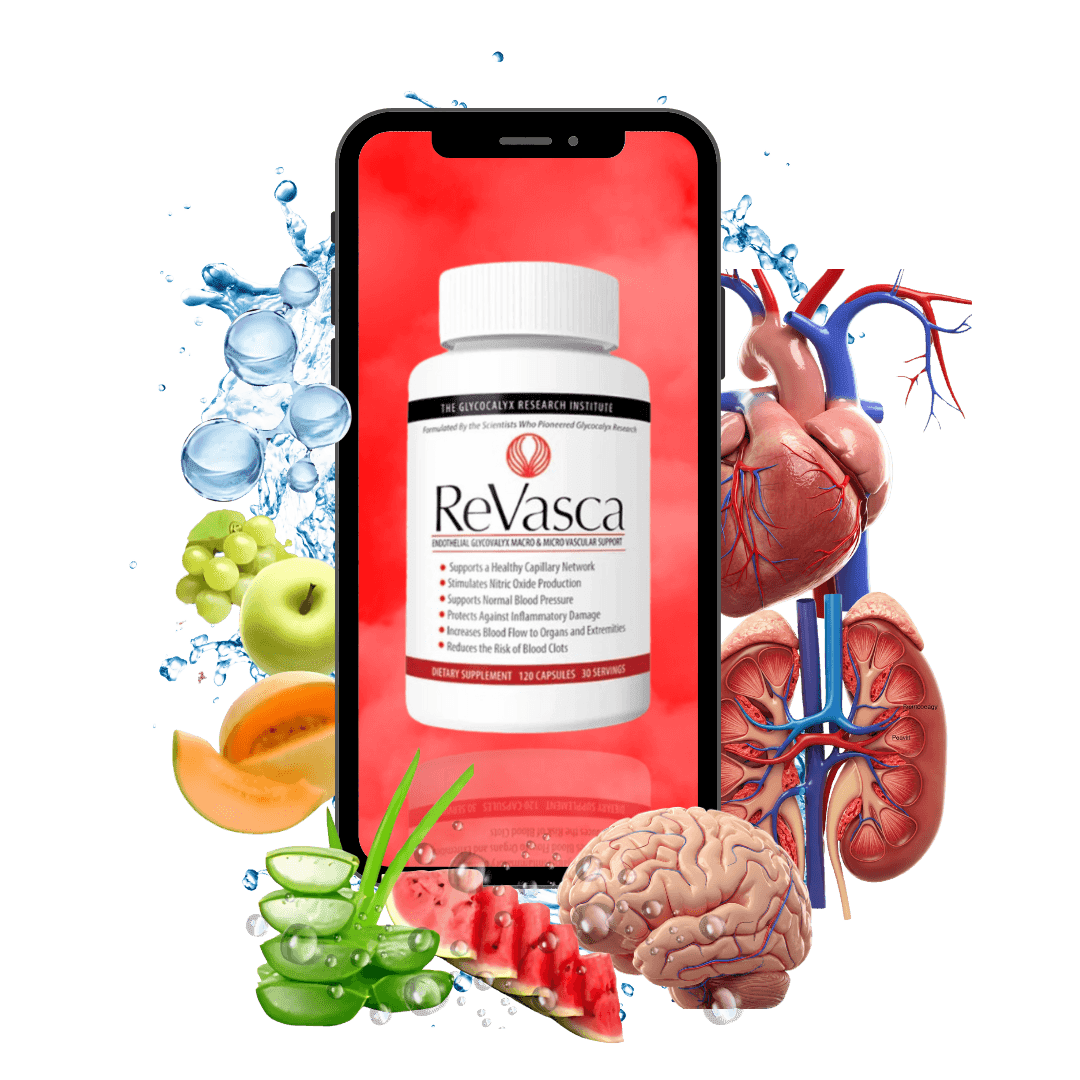
Robert Long, Co-Founder, Director of Nutraceutical Research, is a research collaborator with Dr. Vink and the developer of the glycocalyx-regenerating nutraceuticals, the latest refinement being ReVasca™. He formulated the glycocalyx nutraceuticals, and Dr. Vink validated their efficacy with GlycoCheck™.
🌐 Connect with Robert Long
🔹 Website:https://glycocalyx.com/
Don't miss out on our exclusive early bird offer. Enroll now for a huge saving of 30% off!