
SPEAKER | DR. HANS VINK
Decoding the Microvascular System: How GlycoCheck is Revolutionizing the Way We Measure Health
Scroll below to watch session...

SPEAKER | DR. HANS VINK
Decoding the Microvascular System: How GlycoCheck is Revolutionizing the Way We Measure Health
3 Key Takeaways
The Glycocalyx is the "Hidden Protector" of Your Health
You Can Measure—and Restore—Your Glycocalyx Healthdentify what is going
A Healthy Glycocalyx Makes All Other Treatments and Supplements More Effective
Welcome back to the future of personalized Medicine Summit. I'm Steve Adams from Tiger Medical with Dr. Hans Vink. Dr. Vink let me give you a little bit of background on him. He has been a tenured professor. 30 plus years at the University of Amsterdam and the University of Matric in the Netherlands.
[00:00:19] And he's also the person credited in the literature for discovering a new organ called the Glycocalyx, that we're gonna talk a little bit about today. But most importantly, what he is gonna talk about is how it gets damaged, but then how you, how can you restore it, and what are the implications of that?
[00:00:38] Dr. Vink, welcome to the summit. Thank you Steve. My pleasure to be here. Yeah, and just so you know, Dr. Vink is also the Chief Science Officer of the Glycocalyx Research Institute and Genesis Health Sciences. Full disclosure, I'm involved with this company as well as an executive. So we are partners and we work together, but this is next generation Science and we wanna make sure everyone here gets to hear about it.
[00:01:04] And I wanna make this really important statement if you're here. To optimize your health and enhance the odds of greater longevity. What we're gonna talk about today should be a foundational aspect of everybody who's on that journey. Dr. Vink can you maybe give us a couple minutes, it can be five minutes, whatever, just your story about.
[00:01:26] How you became the world's most renowned researcher in this area of Glycocalyx Health and discovering the glycocalyx and maybe what the science path was for you. Here, Steve, I'll try to put it in a few minutes. So originally I was trained as a physicist in the late 90 eighties. And as part of my physicist training, I did some rotations in different workplaces.
[00:01:51] And one of them was in the academic medical center in Amsterdam and the head of department called medical physics. And that's a mixture of all kinds of people working there, physicists, engineers, but also clinicians physiologists. And it happened the moment I entered that lab to do a tour.
[00:02:08] One person that I started working with Peter Weinger, he just returned from the US and he had some, made some wonderful video recordings of living tissues, small blood vessels, showing how red blood cells flow three small capillaries, one at a time. And seeing these videos and hearing his story, it became apparent that there was this big discussion ongoing.
[00:02:31] Why are there so few red blood cells in these scap when you look at them live? And there was this wild hypothesis that maybe. There's something inside these small blood vessels that's invisible, transparent, nobody knows that might occupy two thirds or three quarters of the volume of the vascular system and nobody knows about it.
[00:02:51] So that triggered my curiosity starting, making many of these videos. And I work with my future mentor Brian Doling in Charlottesville, Virginia. And with him, we realized really there is something inside these small blood vessels. There's a gel inside small blood vessels that stuck to the wall.
[00:03:10] It's a protective gel called glycocalyx. And then we've developed some techniques to image glycocalyx, really showing that, more than 50% of the volume, these small blood vessels is filled with this protective gel. And then, we figured out that, when you break down this gel and it, it's damaged when you're exposed to all the classical risk factors.
[00:03:29] So if you smoke, Or you don't watch your diet or you get older or you don't control your glucose or insulin levels or your blood pressure levels. And the first thing to be damaged is this protective glycolic gel. And then when the gel is damaged, you lose a lot of your vascular protective functions, so you produce less nitric oxide, so your vessels will constrict and your blood pressure will go up, your vessel will surface, becomes very sticky.
[00:03:55] 'cause the gel is a lubricant. And when it's gone. Everything will stick. Robot cells, blood platelets for coagulation, but also inflammatory cells will stick, of course inflammation. And also the festival becomes very leaky. So fluids will leak. You get edema, swollen hands and ankles. You'll lose your proteins that you'll see in your urine at early onset of kidney disease, for instance, but also larger molecules.
[00:04:19] Like cholesterol, the bad cholesterol will easily leak in your vessel wall when your glyco, gallic protective gel is damaged, the triggering the onset of atherosclerosis. So fooling around for a few decades in experimental settings, it became obvious that this gel is not only real, it's very thick, and also very important to keep your blood vessels healthy.
[00:04:39] And that triggered. The next step to, to develop a medical device called Glyco Check to be able to measure if your glyco and your microvascular is in good shape also in humans, in healthy humans, and in patients. And so that kept me busy for the last, 15 years or so. Wow. That's impressive.
[00:04:56] And talk a little bit about the device. Like you, it's had 15 years of research really validating that it is an accurate. Method of measuring. The current condition of your microvascular health, is that correct? That's absolutely correct. No. When we made that switch from just, research settings big microscope in experimental research models to a medical device to be used in humans, we, we use a small handheld video microscope.
[00:05:25] And you can just put it in your mouth. And you have live imaging, how red blood cells flow through capillaries. And one thing that we learned in the earlier studies, if you. Look closely how red cells flow through capar blood vessels and how, and especially when they get close to the surface of the blood vessel wall, you would think they would touch the wall because the red blood cells need to be squeezed and deformed into these small tubes that don't really fit.
[00:05:50] So these are five micron diameter vessels, and the red blood cells are about seven microns. So they squeezed. But when you look closely, they don't touch the wall. They don't even get close to the wall. There's this thick glycocalyx compartment in between the red blood cells in the center of the vessel and the luminal surface of the endothelial cells that make up the wall of these microvessels.
[00:06:11] So in healthy vessels, the red cells all stay nicely in the center of the vessel and don't touch the vessel wall surface 'cause the glycocalyx is in between. So one thing we realized as soon as Glycocalyx gets damaged by, any risk factor that we can think of, then the no, the glyco case will become mechanically less stable.
[00:06:29] Goes highly permeable. There's holes in glycocalyx, and then the red cells will just punch little holes when they flow through the vessels and get very close to the endothelium. So by measuring the distance of the red cells to the endothelium and how they try to move into that protective. A zone of glycocalyx, that's a very, turns out to be a very accurate measure of measuring glycolics damage.
[00:06:52] And now of course in, in the past we did validate, if that method is accurate. So comparing with, electro microscopy or atomic force microscopy, all kinds of other imaging methods that are very accurate to see if the functional measurement of glycolics with the red blood cells. If that, correlates well with the other measures and it does.
[00:07:13] But no, the best proof is in all the clinical studies that we have been doing. So people have been using the Glyco check device now in, in over 200 different academic medical centers now in all kinds of different clinical studies and time over time. The Glyco check system underlines the break of your glycocalyx is one of the earliest steps of vascular damage in wide variety of patient groups.
[00:07:39] I think you were gonna share some slides where you could show. The company has developed a nutraceutical that mimics the processes in the body that actually can restore the glycocalyx, which is really the hope in this message today. It's not all bad news, like you can actually do something about it, and I'll say right here.
[00:08:02] My scores have improved over the last three months since I started adding that. I was already doing the lifestyle factors really well. So the ska has been just that last piece that has helped it all come together and improve both of my measures. Yeah. Let me show you a little bit about that ska supplement.
[00:08:26] This is Keith. People that are watching, just listen here because he's gonna explain the underlying mechanisms that are in the supplement that actually correct the problem we've been talking about. So just to, before we switch to the supplement on the left, the Glyco check system.
[00:08:43] So it's a little handheld microscope and the computer and the software to automatically measure the health of your glycocalyx and how many small cap layers you have and all those parameters. And the Reka is, a third generation supplement that Bob Long and I worked on over the last.
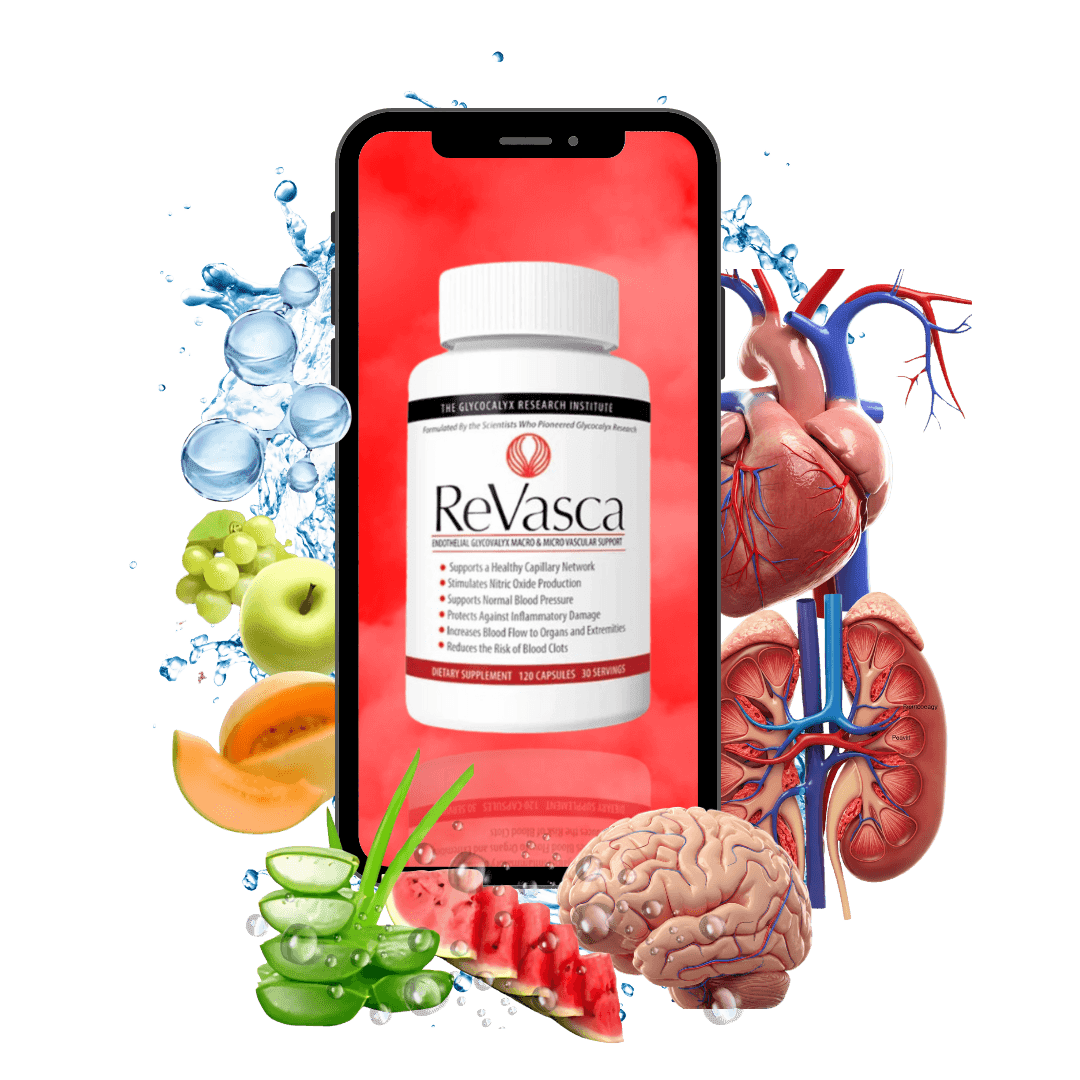
[00:09:00] 15 years also to optimize the therapeutic targeting, really to improve the health of the Glycocalyx. And Reka has six main components that all have different functions to help you improve the health of your glycocalyx. So one of the most important one is a seaweed called fco. And the seaweed? If you look at the molecular structure of the seaweed, turns out to be an hybrid.
[00:09:28] Of two known polysaccharides heparin, sulfate and control in sulfate. It turns out those are the main polysaccharides that are just growing in your own natural glycocalyx. So we've done a lot of testing and it mimics perfectly the properties of your own. Glycocalyx polysaccharides. So what happens is when your glyco kicks are compromised and there's holes in your glycocalyx, any of the FCO circulating in your blood will instantly associate with your festival surface filling up those holes and rebuilding a couple of micron thick, mechanically stable new glycolic coating that will prevent even activated leukocytes from sticking to the wall.
[00:10:13] So it really is really. Very fast in repairing the holes. Another exciting property of that f Cordin is because it's so similar to the end dutches heparin sulfate. Glycans. It also is a very good inhibitor of an enzyme that's targeted against those heparin sulfate. So the enzyme is heparinase and the heparinase enzyme now when you have the foco present, will bind into the foin and doesn't target your own glycolic.
[00:10:43] So it deactivates that enzyme that is responsible for a lot of the breakdown of glycocalyx. In different patient groups. Similarly as the fain there's another polysaccharide called hyaluronic acid. Hyaluronic acid actually is very similar in structure as heparin sulfate. But we do know that especially the high molecular weight, hyaluronic acid molecules form a big part of the volume of glycocalyx.
[00:11:10] So hyaluronic acid molecules are huge and they can bind up to a thousand times their own weight in water. So basically the glycocalyx is polysaccharides, but only 1% of the volume of glycocalyx is polysaccharides and 99% is water bound to proteins that bind to these polysaccharides. So hyaluronan is very important for the volume and the water content of your glycocalyx.
[00:11:37] Another important polysaccharide that we. Added in this last generation supplement is what we rebranded Vaca Man, which is high concentration of the Ace Manin polysaccharide and ace. Manin. Polysaccharide comes from the lo vera plant, and that has been used for thousands of years to treat skin issues burn wounds that turns out to be a very powerful immune modulator.
[00:12:07] Really. Optimizes your immune system to whatever, whenever your immune system needs to kick in to be ready to go and really help you to improve much faster from all kinds of immune challenges. So those are all three polysaccharides, three different kinds. And another important property of glycocalyx is to help your vascular water produce more nitric oxide and a good balance between nitric oxide production, but also the scavenging of oxygen radicals locally produced at deactivated nitric oxide is also very important property of your glycocalyx.
[00:12:44] So to help your glycocalyx to deactivate oxygen radicals, we added. Natural sources for two enzymes, superoxide, dys, mutase, and catalase. So those binds within the polysaccharides of glyco are very close to your vessel wall, and they capture and deactivate locally produced oxygen radicals, so thereby preventing breakdown of your glycocalyx, and then to further help your vascular wall to produce more nitric oxide.
[00:13:11] We added to other components. Citraline is used by your endothelial cells to produce more nitro nitric oxide, so substrate for nitric oxide production. And also polyphenols from the skin of apples and grapes that you find in a compact called Fin nitrox really help also to produce more nitric oxide with your, so all these combined.
[00:13:34] They're all very powerful, but then they have synergistic effect on each other. 'cause if you have more polysaccharides, it will produce more, also more nitric oxide. 'cause your endothelium uses glycocalyx to sense blood flow, produce nitric oxide. But the nitric oxide is more effective if you can scavenge oxygen radicals.
[00:13:55] And then with the finite trucks, even have more powerful production Nitric trucks also altogether. They really help and form a very powerful mix to improve the health of your vascular wall. And I had you do this because so many supplements are pushed. I. I wanted our audience to see the level of science that's gone into this.
[00:14:19] Yeah. Maybe I can just illustrate a little bit, how do we test, how do we test which polysaccharides are functional, for instance? Sure. So when I go to this slide, so this is some of the experiments that we have been doing to test now, if the polysaccharides really help you to repair your glycocalyx. So what this is a.
[00:14:38] Small blood vessel we call a vein, that takes the blood from the microvasculature back to the heart. And those vessels are very important. Also for inflammatory responses. A lot of the immune cells will stick to the wall of these kind of vessels, and then see if there's an issue. So in this setting, we did damage glycocalyx before.
[00:14:57] So if you look closely, on the other side here, the valve with the flowing blood, these little larger cells, little bit transparent, moving slowly over the vessel wall. Those are leukocytes that try to stick to the wall. And in attempt to repair glycocalyx, we put a little microneedle inside this vessel just on the top of the screen, outside the field of view.
[00:15:17] And every few seconds we can inject small amounts of fluid. And this time we added, polysaccharides, like fucidin into the fluid and put a dye label on the fain polysaccharide. So the light dye that we are injecting is actually. Molecules that we inject into the blood. And then actually treating this left side of the vessel.
[00:15:37] We realize that by the small amount of Acord that we inject, it only, no is exposing the left side of the vessel wall doesn't get to the other side. But if you do that within a minute, you'll find. Bright fluent lining of new glycocalyx on the inside of the vessel wall. However, we zoom in a little bit.
[00:15:56] So you see here this is black. The black line is the vessel wall endothelium, and after no a couple of minutes of injecting the for cordin, there's a very thick new coating of a couple of micron thick for cordin based glycocalyx that's mechanically stable and it's very thick compared to the adhesion molecules presented by, inflammatory challenges on the endothelium and be perfectly able.
[00:16:20] Yeah, to mechanically prevent inflammatory cells to stick to the wall. It's interesting is this was 10 years before the first product Art TESOL came out. Yeah. So we have been working on this already for years. So these tools really helped us to test different polysaccharides. And then, for instance, we measure how many leukocytes are sticking to the wall causing local information.
[00:16:44] So this is just an example of such a challenge if we damage glyco calix either by, risk factors like cholesterol, or, more specifically with an enzyme called hyaluronidase, which breaks down those hyaluronic acid glyco glycans. And you count on the vertical axis how many inflammatory cells will stick to the vessel wall causing inflammation.
[00:17:07] Oh, so the Red bar show, if you don't. Treat your glycations properly, then within half an hour, you can have a threefold increase in inflammatory cells sticking to the wall. Wow. So the wall gets very sticky. And you know it's good when it's needed, but if your glycocalyx is just being challenged by risk factors like smoking or diabetes, you don't want this kind of inflammation in your vessels.
[00:17:29] So adding a supplement like Veka to your. Diet and having increased levels of these polysaccharides circulating in the bup continuously checking and repairing your glycocalyx, and even in the presence of a challenge then it's still perfectly able to rebuild your glycocalyx and prevent all these inflammatory cells to start, sticking to your wall and causing all kinds of inflammatory problems.
[00:17:56] Yeah so these tools are very powerful. To help you, repair your glyco cake and prevent all kinds of problems with inflammation or coagulation or loss of nitric oxide production. Yeah, it has been an, a fun journey to be on the last 10, 10, 15 years with Bob Long and optimizing the supplements and I think this is the best supplement so far that we ever developed.
[00:18:17] Your research started in the late eighties and your research built on research that started, I think you said in the early seventies is when it first started on this. Yeah. So this has been going on some, I'm almost 40 years working on this one topic, yeah. No getting interested, finding evidence of glycocalyx seed that is.
[00:18:36] Hugely important to keep your vessels healthy, translating that into a tool that we can use in humans and clinical studies and in, preventative doctor's offices. Within minutes now we can assess your vascular health and how your glycolic is doing, and check if the therapeutic that you're taking to improve your health is really functional.
[00:18:56] So that's not just right by hearsay. So you can measure, very quantitatively how healthy your microvascular New York glycolic is and if Bravas is really working for you. Now, the point I was just making was though, is that this bottle of vascular that was shown on the graphic earlier is really the result of 55 years of research almost, and and result of your 40 years of research, it didn't just happen.
[00:19:23] This isn't a guesswork. These are no. And it's an ongoing story. So you know, right now, and I was surprised how open armed we are welcomed by the academic community to test supplements like Reka in all kinds of clinical trials many patients. There's nothing else.
[00:19:43] There's nothing available to start, prepare the vascular system and try to mitigate all kinds of loss of function in different organs. So we are in. Over 10 clinical trials right now, full-blown clinical trials using a dietary supplement to test in all kinds of patient groups if we can improve their health.
[00:20:01] And so far, everything looks very positive. Yeah. And historically, you've had about half a dozen, about a dozen studies in the past because there's hundreds on the glyco check device. The studies are now starting to pile up on the Reva. Yes. They're, and so far they're all confirming that when you, they're all confirming that we are able to rebuild your glycocalyx, right?
[00:20:27] And if we do rebuild your glycocalyx, all kinds of functions associated with glycocalyx are stored. So you produce more nitric oxide, you're better able to control blood pressure. Your vascular wall stiffness reduces. So it's also like an anti-aging. Therapeutic that helps you to make your blood vessels more flexible.
[00:20:47] It also helps you to control your blood pressure. It helps you to protect all against all kinds of challenges, like with Covid, for instance. The the covid the toxins in
[00:21:02] stored. So all kinds of studies ongoing and all very positive. And the other thing too is just lifestyle alone won't do it because, I'm a good example, I own a lifestyle medicine company. I'm one of these one percenters who, when a doctor says, I need you to do these eight things, I do 'em and I do 'em seven days a week.
[00:21:24] And I've done that since 2019. Yet I had not a really, very good score, and I had actually some significant damage that PBR score that you showed. 2.1, mine was 2.64 when it started. And SKA has improved that already significantly. And brought my microvascular score up and my damage score down.
[00:21:48] And so just lifestyle alone. No. And and that doesn't mean people should not pay attention to lifestyle, do it, right? We are, no. We're also in a study on the impact of different exercise protocols on your vascular health in New York, glycocalyx. So there was a study on high intensity interval training and the interesting.
[00:22:09] Thing is that some people, even after the first exercise bout they have an an increased level of some epigenetic markers that respond to exercise and those markers actually also control very strongly with. Improvement of microvascular health and glycocalyx, right? Not all the people doing the same exercise show that response, right?
[00:22:29] Some people, for some reason, genetically respond very well to exercise and can repair the glycocalyx, but some others don't. You need something on top of regular exercise to make sure you do improve your microvascular health. I, this test was actually the canary in the coal mine for me, because I've went to the medical system.
[00:22:49] They measured the 1%, which is the big large arteries. What we measure is the 99%, which is the micro vasculature, my 1% was just fine, but the score said your 99% is not just fine. And so it caused me to go digging and I went and got like a next generation cardio test. It's called an MCG. And what we found was is I have micro capillary blockage.
[00:23:17] It's rare for white males. It's only 15% of white European of descent males have micro and not macro, but 49% of women do and people of color have a lot higher levels of micro vasculature. Blockage. The other thing though that's really cool about this device is the measurement is that it picks it up early and you can do something about reversing it and.
[00:23:46] What the doctor told me that where I got this advanced measure said that if you have MBO vasculature, blockage, it can migrate very quickly into the major vessels. And so you think you're fine. And then a very short amount of time it can just migrate into there. And so the good news for me, the other thing I learned from me, Hans, is I have this genetic marker called the M-T-H-F-R.
[00:24:10] About half the public has it. What that does is that you don't make the buildup. There's a missing link in this chain. And so I don't make nitric oxide, serotonin, dopamine, norepinephrine, or melatonin at all after age 50. And so what, so this device helped me go look, and I learned all this, and now I'm getting treated with methylfolate to replace that missing thing.
[00:24:37] And now nitric oxides firing. Serotonin's firing. Everything's firing. And I'm also, but the doctor said, you absolutely have to take a double dose of Reba. He said that with what I'm giving you with good lifestyle will completely reverse this. And you'll have lower risk than 99% of the population and 18 months.
[00:24:58] That's the good thing is you found out in time. Yeah. So time enough to do stuff, something about it. Exactly. Yeah. And that's the opportunity here. And there was one other thing I was gonna ask you, and I'm trying to think of what it was. I can't think of it right now. Is there so one thing that Bob said and I wanna reinforce is we don't, there's not a lot of glyco checks distributed around the world right now.
[00:25:18] We're starting to do that. There's nothing that's stopping anybody from just going ahead and getting on the supplement because it really is foundational and and what would you say, Hans, that. If the glyco alx is compromised in someone, in some ways, they're wasting money on other supplements until they address this.
[00:25:40] The only way any supplement or any drug will get, I. Where it needs to go in any organ, any cell. You need a healthy microvasculature first. So you know, if you don't have a healthy microvascular here, and we did see already at early stages, even healthy people exposed to risk, like in a big obesity study that we did.
[00:26:00] So these people, were completely healthy and they wouldn't get any obvious organ complications for the next five or 10 years. But even these people exposed to risk some of them show more than 50% loss of their microvasculature so that they're missing a lot of that capillaries and micro sections of organs don't get the nutrients that they need so you can have the best nutrients.
[00:26:24] The world. If you don't have your micros in place, it doesn't get to those sites at risk. So you need to repair your microvascular first. And that's key before you can actually expect other nutrients to get to the places where they need to go. Wow, that's powerful. The way you find this is to go to glycocalyx.com and it's G-L-Y-C-O-C-A-L-Y x.com.
[00:26:50] It's not an easy word to spell. But it'll be in all of the show notes Summit, you can see in my background here too. Yeah. You have to duck to get the whole picture, but, yeah. Dr. Hans, I don't know if people really understand. They are, they have been listening to the person who was on the leading front of discovering this and bringing it to the world.
[00:27:10] Millions and millions of people are gonna benefit from this. And we're grateful for all the work you've dedicated your life to Thank you for being on this. It has been a great journey and looking forward to all the stuff that we can still do together. Steve? Yeah. Okay. Thank you. Thank you.
About Dr. Hans Vink
DR. HANS VINK | SPEAKER
Dr. Vink, Co-Founder, Director of Advanced Research, is a glycocalyx research pioneer, the world’s leading glycocalyx researcher, and the inventor of the GlycoCheck™ testing device. He has published over 250 scholarly papers on the glycocalyx, and his research has been cited in more than 16,000 citations.
🌐 Connect with Dr. Hans Vink
🔹 Website:https://glycocalyx.com/
Don't miss out on our exclusive early bird offer. Enroll now for a huge saving of 30% off!